CQRS with MediatR, Revisited for .NET 10
A 2024 guide to CQRS with MediatR, rebuilt from scratch on .NET 10 instead of patched in place: what MediatR 14's license actually requires in practice, minimal API endpoints and IExceptionHandler replacing the original's placeholder exception behavior, SQLite in memory replacing a mocked DbContext in tests, the Native AOT limitations of reflection-based handler discovery, and a source-generated alternative that sidesteps the license question entirely.
.NET October 2026 Out-of-Band Security Updates
<p>Out-of-band security updates for .NET address the Brotli decoder vulnerability and tarball ownership vulnerability.</p> <p>The post <a href="https://devblogs.microsoft.com/dotnet/dotnet-october-2026-oob-security-updates/">.NET October 2026 Out-of-Band Security Updates</a> appeared first on <a href="https://devblogs.microsoft.com/dotnet">.NET Blog</a>.</p>

Blazor Community Standup: Free Syncfusion Toolkit for Blazor
Join us with the Syncfusion team to explore the free and open-source Syncfusion Toolkit for Blazor. We’ll see the components in action and show how you can use them to build your own Blazor apps. 🔗 Links: https://www.theurlist.com/blazor-standup-20261029 🎙️ Featuring: Daniel Roth, Shriram Sankaran #dotnet #aspnetcore #blazor

.NET Data Community Standup: Teach your AI agent database design with T-SQL static code analysis
Erik will show two ways you can take advantage of the open-source set of T-SQL static analysis rules, and the surrounding set of tools, that he maintains. First, you can get live code analysis of your SQL scripts as you type them in VS Code, Visual Studio and SQL Server Management Studio. Secondly, in companionship with EF Core Power Tools, you can build your database model (and EF Core model) with AI and guide it by enforcing the more than 140 rules in the package. 🎙️ Featuring: Jiri Cincura, Erik Ejlskov Jensen #net #data #efcore #tsql #vs #vscode #ssms
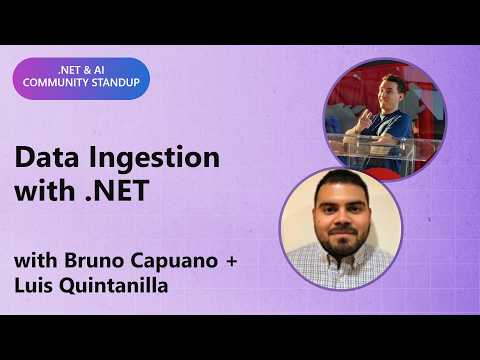
.NET AI Community Standup: Data Ingestion with .NET
Building AI applications with .NET takes more than connecting a model. It takes making your data useful. Join this AI Community Standup to explore how .NET’s building blocks for AI (Microsoft.Extensions.AI), data ingestion (Microsoft.Extensions.DataIngestion), and vector data (Microsoft.Extensions.VectorData) come together to solve that challenge. Discover how data ingestion, embeddings, and vector search support context engineering, including retrieval-augmented generation (RAG), to help you build practical AI applications grounded in your own documents and business data. 🔗 Links: https://learn.microsoft.com/en-us/collections/ng62sjt1k4jjep 🎙️ Featuring: Bruno Capuano (@elbruno), Luis Quintanilla #AI #DataIngestion #DotNet

How to Keep Your Architecture Diagrams Accurate
🩵 Check out our sponsor, IcePanel. Create your free account here: https://icepanel.io/?utm_source=youtube&utm_medium=paid&utm_campaign=gui Your architecture diagram was true the day you drew it. Then the code kept moving. With a coding agent writing features in minutes, it now moves faster than anyone updates the diagram. In this video I show how I keep the diagrams in line with the code. Fetch is the app I use every day to publish from Notion to X, LinkedIn and Instagram. I generate the C4 diagrams (levels 1 to 3) straight from the repo with IcePanel's skill. I connect the IcePanel MCP server at project scope, so it lands in .mcp.json and everyone on the team gets it. One line in CLAUDE.md tells the agent to go there for high-level questions about the system. Then I compare three places to keep the diagrams fresh: CLAUDE.md, a hook, and the pipeline. The short version: put the refresh where it runs every time, not where someone has to remember it. For a team, that's the merge into main. CHAPTERS 00:00 Intro 04:49 Generating C4 diagrams 08:50 Letting the agent query the diagrams 13:27 Keeping it fresh LINKS IcePanel: https://icepanel.io/?utm_source=youtube&utm_medium=paid&utm_campaign=gui IcePanel plugin (skills): https://github.com/IcePanel/icepanel-plugin IcePanel agent skills docs: https://docs.icepanel.io/integrations/agent-skills IcePanel MCP server docs: https://docs.icepanel.io/integrations/mcp-server C4 model: https://c4model.com Claude Code MCP docs: https://code.claude.com/docs/en/mcp Claude Code hooks docs: https://code.claude.com/docs/en/hooks Claude Code GitHub Actions: https://code.claude.com/docs/en/github-actions #claudecode #softwarearchitecture #aiengineer
%20in%20.NET)
An introduction to Compact Binary Object Representation (CBOR) in .NET
In this post I introduce CBOR as a JSON alternative, and show how to use the System.Formats.Cbor NuGet package to read and write CBOR encoded data

Yes, C# is faster than Rust
A genius has just benchmarked the Rust port of Campfire to .NET and C# and the results are incredible! #dotnet #csharp #coding
Localize Minimal API Validation Messages in .NET 11
ASP.NET Core 11 localizes Minimal API validation messages. Wire up AddValidation and AddLocalization, add resx files, and return errors per culture.
Get Your .NET MAUI App Ready for Xcode 27
<p>Use an agent skill to prepare your existing .NET MAUI app for Xcode 27, with the scene lifecycle changes and manual migration steps explained.</p> <p>The post <a href="https://devblogs.microsoft.com/dotnet/migrate-dotnet-maui-apps-uikit-scene-lifecycle/">Get Your .NET MAUI App Ready for Xcode 27</a> appeared first on <a href="https://devblogs.microsoft.com/dotnet">.NET Blog</a>.</p>
Bring Your Own Model to the GitHub Copilot SDK with C#
<p>The GitHub Copilot SDK gives your application an agent runtime. BYOK lets you keep that runtime while sending model requests to your own Microsoft Foundry or Azure OpenAI deployment. Here is the complete C# setup.</p> <p>The post <a href="https://devblogs.microsoft.com/dotnet/bring-your-own-model-to-the-github-copilot-sdk-with-csharp/">Bring Your Own Model to the GitHub Copilot SDK with C#</a> appeared first on <a href="https://devblogs.microsoft.com/dotnet">.NET Blog</a>.</p>
Your Database Column Is Encrypted. Your JSON Response Isn't.
An EF Core value converter can encrypt a database column before it reaches storage, but the entity comes back as ordinary C# strings the moment the application reads it — and System.Text.Json serializes those values exactly like everything else. Here's how a JsonTypeInfo modifier encrypts specific properties at the serialization boundary with AES-GCM, without touching the domain model or the database mapping, and where this control helps, where it doesn't, and why it has to work alongside data minimization and log redaction, not replace them.